
EOT Crane Price in India: What Decides the Cost
Understand EOT crane pricing in India using real factory benchmarks: single girder from Rs 1.5 lakh, double girder from ...
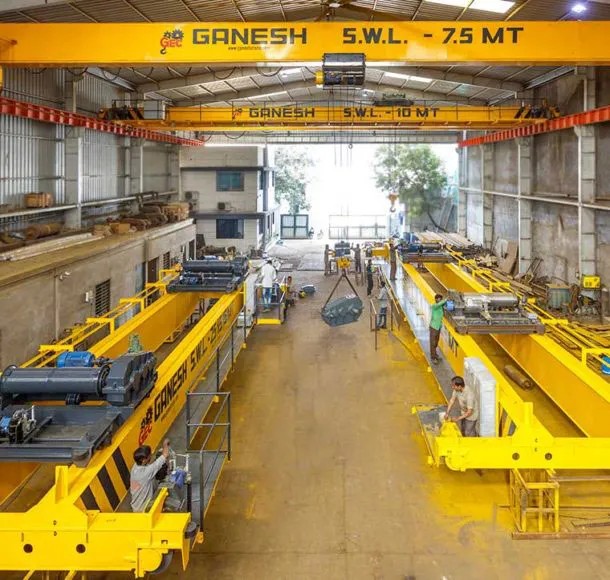
Many established workshops in Odhav, Naroda, Rajkot, and Ludhiana operate inside older sheds where roof trusses sit low above the crane runway brackets. When a plant upgrades machinery or starts handling taller dies, a standard underslung hoist hangs too far below the bridge girder and steals critical lifting height. Low headroom EOT cranes solve this without rebuilding the shed roof.
Instead of hanging the wire rope drum and motor directly underneath the bridge girder's bottom flange, a low headroom hoist mounts the drum beside the girder web with a compact counterweight on the opposite side. This pulls the hook block right up to the bottom flange, reclaiming 350 mm to 550 mm of vertical travel.
In a standard underslung wire rope hoist, the rope drum diameter, motor housing, and trolley side-plates stack vertically below the girder, costing nearly a meter of headroom.
By shifting the barrel parallel to the I-beam or box girder, only the compact sheave block sits beneath the beam. For workshops struggling to load tall CNC beds or stack pallets onto trucks, that reclaimed half-meter makes the difference between clearing a machine and having to raise the entire factory roof.
Even better, the bridge girder itself can be built as a stiff box section with end carriages notched upward so the bridge sits as close as possible to the roof truss.
At a customer facility in Ludhiana, our Vatva plant supplied and installed a 5 t low headroom single girder EOT crane spanning 13.775 meters. Built to IS 807 and IS 3177 standards, the custom bridge maximized clear hook height inside an existing low-clearance workshop bay.
Older industrial sheds in Punjab and Gujarat rarely have surplus vertical space between the gantry rail top and the lowest roof purlin. Measuring exact truss clearances allowed our design team to match the end-carriage wheel center height and low-headroom hoist profile to the shed's exact millimeter envelope.
The unit shipped from Ahmedabad on a flatbed trailer after clearing full factory load and deflection verification, using Tata and SAIL structural steel, Usha Martin wire rope, and Crompton/Siemens motors.
Comparing duty classes, structural spans, and drive hardware side by side helps plant engineers match crane specifications to shop-floor conditions before issuing a purchase inquiry.
| Configuration | Typical Capacity | Headroom Loss Below Beam | Recommended Use |
|---|---|---|---|
| Standard Single Girder | 1 t to 20 t | 750 mm to 1,100 mm | Tall new PEB sheds with ample clearance |
| Low Headroom Single Girder | 1 t to 15 t | 350 mm to 550 mm | Older low-roof sheds (e.g., 5 t Ludhiana 13.775 m) |
| Double Girder Top-Running | 5 t to 100 t | Hook rises between girders | Heavy bays 20 t+ needing maximum lift height |
Choose a low headroom single girder EOT crane for loads from 1 t to 15 t where existing building columns cannot carry heavy twin-girder deadweight. Choose a double girder crane when loads exceed 20 t or when the hook must rise all the way up between two main beams.
In a double girder EOT crane, the crab trolley rides on rails welded atop twin box girders, allowing the hook to ascend into the gap between the girders. However, a double girder bridge weighs more and needs stronger shed columns.
For existing sheds with light column brackets, a low headroom single girder crane delivers most of the hook-height gain at lower deadweight and lower starting cost.
Measure three exact dimensions in your shed: distance from floor to runway rail top, clear space from rail top to lowest roof truss or light fixture, and span from rail center to rail center. Sharing these numbers lets our Vatva engineers draft an exact GA drawing.
Do not forget to check side wall clearance beyond the rail centers so end-carriage drive motors clear building columns cleanly. Adding VFD dual-speed control ensures smooth travel without swinging loads near tight roof trusses.
Every crane built at Ganesh Engineering Co. follows IS 807, IS 800, IS 3177, and IS 4137 design standards, backed by factory load and deflection verification before leaving Ahmedabad. Buyers receive verified material specifications for Tata and SAIL steel plates, Usha Martin wire ropes, and Crompton or Siemens drive motors.
During fabrication in GIDC Vatva Phase-IV, our 26 to 50 person team checks box-girder weld seams, diaphragm spacing, and upward design camber so full-load vertical deflection stays strictly within Indian code limits. End carriages are line-bored to keep forged double-flanged wheels parallel, preventing rail flange scrubbing and uneven wear along your factory runway.
Before trailer loading, each hoist and bridge assembly undergoes mechanical running trials, brake-holding checks, rotary limit-switch calibration, and full rated load and deflection measurement on our test bay. This ensures that when parts reach your site, electrical panels and mechanical assemblies match the approved general arrangement drawing without hidden defects.
Checking shed column bracket levels, runway rail gauge, and three-phase 415 V power readiness before trailers arrive cuts site erection time in half. Confirming clear trailer gate access, overhead door clearance, and mobile unloading crane positioning also keeps installation moving smoothly from day one.
Plant engineers should verify that gantry rail joints are welded or bolted flush, end-stop buffers sit securely at bay extremes, and earthing leads reach the main runway isolator switch. Having an electrician ready to terminate the shrouded four-pole copper DSL busbar feeder lets our visiting Vatva technicians move straight from mechanical erection into final travel and hoisting checks without unnecessary waiting.
Start by sharing your required safe working load, bay span, hook lift height, and daily operating hours with our GIDC Vatva, Ahmedabad plant on +91-9824089366 or info@ganeshcrane.com. Every crane is designed to IS 807, IS 800, IS 3177, and IS 4137 rules using Tata and SAIL steel, Usha Martin wire ropes, and Crompton or Siemens motors.
Before trailer dispatch, every machine undergoes full load and deflection verification in our Vatva bay. For international buyers across 28 export markets including UAE, Saudi Arabia, Nepal, Bangladesh, Sri Lanka, Indonesia, Sudan, Kenya, and Nigeria, spliced girders and crated hoists ship in export packing with clear wiring diagrams and bolt schedules. You can review full technical parameters on our Single Girder EOT Crane page, inspect regional supply details on Single Girder EOT Cranes in Ludhiana, and examine past heavy-lifting installations on our case studies page. Orders settle cleanly via LC, DD, cheque, or card with GSTIN 24AAHFG9482D1ZB invoicing.
No. A 5 t or 10 t low headroom hoist carries the exact same rated safe working load as a standard hoist; only the drum-to-girder geometry changes.
In many cases yes, provided our engineers inspect the existing girder flange width, box stiffness, and power busbar layout first.
Standard single girder EOT cranes start around Rs 1.5 lakh per piece ex-Vatva, with low-headroom builds priced according to exact span and hoist capacity.
Send your floor-to-truss height, rail center span, and column size to info@ganeshcrane.com or call +91-9824089366 for a layout check.
Understand EOT crane pricing in India using real factory benchmarks: single girder from Rs 1.5 lakh, double girder from ...
When a mobile rubber tyre gantry crane without fixed floor rails saves foundation cost and adds yard flexibility, featur...
Compare heavy gantry cranes vs tower cranes for bridge girders, precast yards, and temple construction, featuring our 10...
Send us your capacity, span and lift height. Our engineers reply with a design and quotation.
Share your requirement. We usually reply the same working day.