
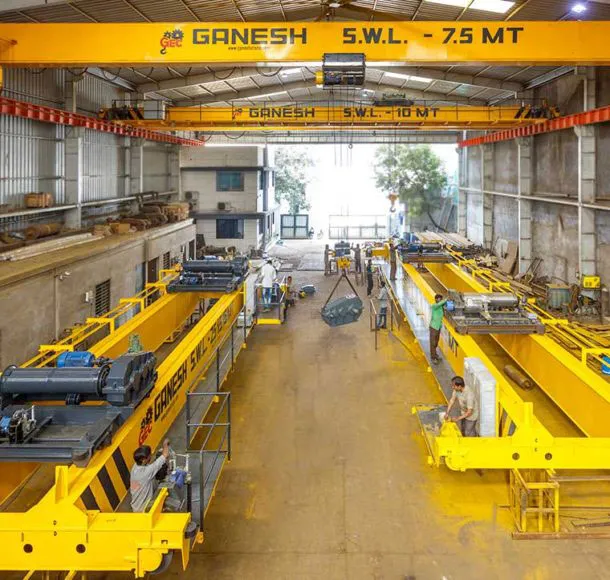
EOT Crane Price in India: What Decides the Cost
Understand EOT crane pricing in India using real factory benchmarks: single girder from Rs 1.5 lakh, double girder from ...
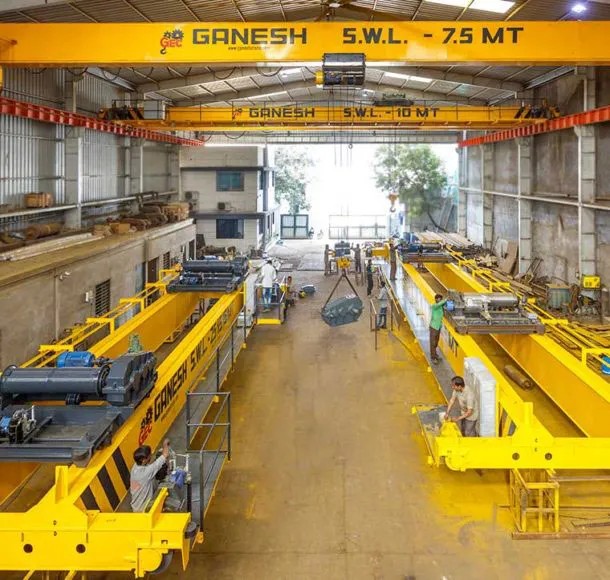
Industrial estates across Shapar-Veraval, Metoda GIDC, Aji, and Lodhika make Rajkot one of India's busiest hubs for grey iron foundries, investment castings, diesel engines, and CNC machine tools. Handling molten metal ladles, sand molding flasks, and heavy forged billets demands a smart combination of main-bay EOT cranes and localized workstation jib cranes.
Main-bay double or single girder EOT cranes (5 t to 30 t) move heavy induction furnace ladles, large molding boxes, and rough castings across the full hall. Pillar or wall-mounted jib cranes (250 kg to 10 t) sit beside individual shake-out stations, fettling benches, and CNC lathes so operators never wait for the overhead bridge.
When a single overhead crane serves ten machining centers or molding bays, workers lose productive minutes waiting for hook availability. Adding a 360-degree freestanding pillar jib crane with a 2 m to 8 m slewing arm gives each machine its own dedicated lifting circle.
In tighter machine shops where floor space around CNC beds is scarce, 180-degree wall-mounted jib cranes bolt directly onto strong building columns, keeping floor aisles completely clear for pallet trolleys.
Meanwhile, the main EOT crane handles bulk raw pig iron charging, heavy die blocks, and finished casting loading onto dispatch trucks.
Moving molten metal ladles or hot forging billets is severe duty and requires Class III or Class IV double girder EOT cranes built to IS 3177 and IS 4137. Dual fail-safe brakes, heat shields under the crab, and high-temperature motor insulation are essential.
Standard Class II workshop hoists are suitable for cold machining and fettling bays, not for pouring molten iron over open molds. Radiant heat rising from induction furnaces rapidly dries out ordinary grease and weakens standard brake coils.
We equip foundry-duty cranes with Crompton or Siemens motors rated for high ambient heat, Usha Martin steel-core wire ropes, and electro-hydraulic thruster shoe brakes that grip smoothly without dropping the ladle if power trips.
Variable frequency drives provide ultra-slow pouring creep speeds so foundry operators tilt ladles steadily without splashing.
Comparing duty classes, structural spans, and drive hardware side by side helps plant engineers match crane specifications to shop-floor conditions before issuing a purchase inquiry.
| Shop Operation | Crane / Hoist Type | Capacity Range | Recommended Duty & Controls |
|---|---|---|---|
| Molten Ladle Pouring | Double Girder EOT Crane | 5 t to 30 t | Class III/IV, Heat Shield, Dual Brakes |
| Molding Box & Flask Shift | Single Girder EOT Crane | 3 t to 15 t | Class II/III, VFD + Radio Remote |
| CNC Chuck & Lathe Loading | Pillar / Wall Jib Crane | 250 kg to 3 t | 360/180-Deg Slewing + Pendant |
| Fettling & Die Maintenance | Wire Rope / Electric Hoist | 1 t to 5 t | IP55 Dust-Sealed + Overload Limiter |
Wall-mounted jib cranes can be fixed to existing RCC or heavy steel columns only after verifying column bending moments, whereas freestanding pillar jib cranes bolt onto their own dedicated concrete foundation pad independent of the shed structure.
Before recommending a wall bracket in Metoda or Shapar-Veraval, our Ahmedabad engineers check column section size, anchor bolt spacing, and boom reach (2 m to 8 m). If existing shed columns carry light roofing loads only, a base-mounted pillar jib transfers all overturning torque safely into a local floor foundation.
Both pillar and wall jibs operate with manual push rotation for light 250 kg to 2 t loads or electric motorized slewing for heavier 3 t to 10 t arms.
All cranes and jib assemblies travel 220 km west from our GIDC Vatva, Ahmedabad plant along NH 47 directly into Rajkot estates. Every machine passes load and deflection testing at Vatva prior to loading.
Our engineers supply foundation anchor-bolt templates in advance so civil pads cure before trailer arrival. On site, our erection team aligns rails or bolts jib pillars, installs shrouded power busbars, and verifies full slewing and hoisting before handover.
Every crane built at Ganesh Engineering Co. follows IS 807, IS 800, IS 3177, and IS 4137 design standards, backed by factory load and deflection verification before leaving Ahmedabad. Buyers receive verified material specifications for Tata and SAIL steel plates, Usha Martin wire ropes, and Crompton or Siemens drive motors.
During fabrication in GIDC Vatva Phase-IV, our 26 to 50 person team checks box-girder weld seams, diaphragm spacing, and upward design camber so full-load vertical deflection stays strictly within Indian code limits. End carriages are line-bored to keep forged double-flanged wheels parallel, preventing rail flange scrubbing and uneven wear along your factory runway.
Before trailer loading, each hoist and bridge assembly undergoes mechanical running trials, brake-holding checks, rotary limit-switch calibration, and full rated load and deflection measurement on our test bay. This ensures that when parts reach your site, electrical panels and mechanical assemblies match the approved general arrangement drawing without hidden defects.
Checking shed column bracket levels, runway rail gauge, and three-phase 415 V power readiness before trailers arrive cuts site erection time in half. Confirming clear trailer gate access, overhead door clearance, and mobile unloading crane positioning also keeps installation moving smoothly from day one.
Plant engineers should verify that gantry rail joints are welded or bolted flush, end-stop buffers sit securely at bay extremes, and earthing leads reach the main runway isolator switch. Having an electrician ready to terminate the shrouded four-pole copper DSL busbar feeder lets our visiting Vatva technicians move straight from mechanical erection into final travel and hoisting checks without unnecessary waiting.
Start by sharing your required safe working load, bay span, hook lift height, and daily operating hours with our GIDC Vatva, Ahmedabad plant on +91-9824089366 or info@ganeshcrane.com. Every crane is designed to IS 807, IS 800, IS 3177, and IS 4137 rules using Tata and SAIL steel, Usha Martin wire ropes, and Crompton or Siemens motors.
Before trailer dispatch, every machine undergoes full load and deflection verification in our Vatva bay. For international buyers across 28 export markets including UAE, Saudi Arabia, Nepal, Bangladesh, Sri Lanka, Indonesia, Sudan, Kenya, and Nigeria, spliced girders and crated hoists ship in export packing with clear wiring diagrams and bolt schedules. You can review full technical parameters on our Jib Crane page, inspect regional supply details on Jib Cranes in Rajkot, and examine past heavy-lifting installations on our case studies page. Orders settle cleanly via LC, DD, cheque, or card with GSTIN 24AAHFG9482D1ZB invoicing.
Industrial jib cranes start around Rs 1.56 lakh per piece ex-Vatva, depending on capacity (250 kg to 10 t), arm length, and manual or motorized slewing.
We fit enclosed IP55 Crompton or Siemens motors, dust-tight limit switches, sealed wheel bearings, and epoxy-coated Tata/SAIL structural steelwork.
Yes. A 360-degree pillar jib crane positioned between two machines with a 5 m to 6 m boom covers both worktables cleanly.
Orders under GSTIN 24AAHFG9482D1ZB settle via LC, DD, cheque, or card, with direct support on +91-9824089366.
Understand EOT crane pricing in India using real factory benchmarks: single girder from Rs 1.5 lakh, double girder from ...
When a mobile rubber tyre gantry crane without fixed floor rails saves foundation cost and adds yard flexibility, featur...
Compare heavy gantry cranes vs tower cranes for bridge girders, precast yards, and temple construction, featuring our 10...
Send us your capacity, span and lift height. Our engineers reply with a design and quotation.
Share your requirement. We usually reply the same working day.