Direct Answer: Every compliant industrial EOT crane in India must integrate six core safety devices under IS 3177 and IS 13367: rotary geared upper/lower limit switches, a secondary gravity-type ultimate over-hoist switch, fail-safe electro-hydraulic thruster brakes, electronic overload limiters (load cells), cross/long travel lever limit switches, and rubber shock buffers.
Overhead EOT cranes carry multi-ton loads directly above plant operators and high-value CNC machines. A single brake failure, control short circuit, or wire rope two-blocking accident can cause severe injury and months of legal downtime. Engineering redundant, fail-safe mechanical and electrical safety mechanisms is non-negotiable.
7 Mandatory Safety Mechanisms on Industrial Overhead Cranes
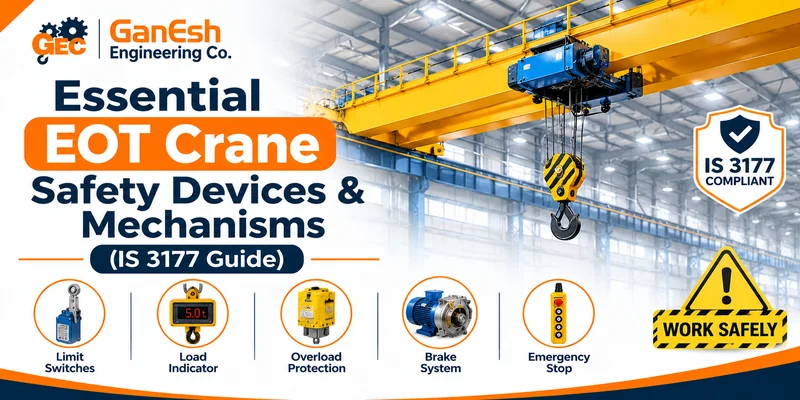
Rotary Geared Limit Switch (Hoisting Travel): Coupled mechanically to the wire rope drum shaft, this switch cuts motor power automatically at preset upper and lower hook limits, preventing the hook block from crashing into the hoist drum or unwinding completely.
Gravity-Operated Ultimate Counterweight Limit Switch: A completely independent backup cutoff mounted directly beneath the hoist frame. If a rotary limit switch fails or phase reversal occurs, the ascending hook block physically lifts the counterweight arm to trip power instantly.
Fail-Safe Electro-Hydraulic Thruster Brakes: Applied across hoisting, cross travel, and long travel drives. These brakes are spring-applied and electrically released, meaning they lock automatically and hold 100% of rated Safe Working Load the instant power drops.
Electronic Overload Limiter with Digital Load Readout: Uses precision shear-pin or rope-clamp load cells wired to the control panel. If an operator attempts to lift above 105% to 110% of rated capacity, the panel sounds a hooter and disables upward hoisting motion while still permitting safe lowering.
Cross & Long Travel Two-Way Lever Limit Switches: Mounted on the hoist trolley and crane end carriages. When approaching runway ends, strike brackets trip slow-down and hard-stop limits before contacting mechanical buffers.
Heavy Polyurethane / Spring Buffers: Installed on both ends of end carriages and runway stopper beams to absorb kinetic impact energy cleanly under IS 807 criteria.
Anti-Collision Infrared Sensors (Dual-Crane Bays): Where two cranes share one bay track (for example, a 10T and a 30T crane in heavy fabrication sheds), optical laser or infrared anti-collision relays automatically decelerate and halt bridges at a safe minimum separation distance.
Operator Control Safety Standards
Low-Voltage 24V / 110V Control Circuits: Pendant pushbuttons and wireless radio remotes operate strictly on stepped-down control transformer voltage rather than hazardous 415V line power.
Lockable Main Isolator & Emergency Mushroom Stop: A bright red latching emergency stop on every pendant and remote cuts main line contactors immediately across all three motions.
Shrouded Copper DSL Busbars: Replaces open bare angle-iron power conductors along the shed wall with PVC-shrouded jointless copper busbars, eliminating electrocution risks during maintenance.
All single and double girder cranes built by Ganesh Engineering Co. at GIDC Vatva, Ahmedabad are 125% proof-load tested before dispatch. Call +91-9824089366 to upgrade older workshop cranes with VFD panels, overload relays, or wireless radio remote retrofits.