
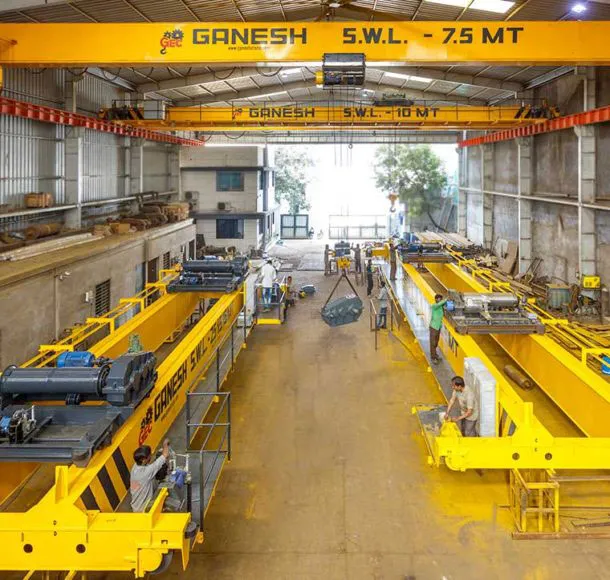
EOT Crane Price in India: What Decides the Cost
Understand EOT crane pricing in India using real factory benchmarks: single girder from Rs 1.5 lakh, double girder from ...
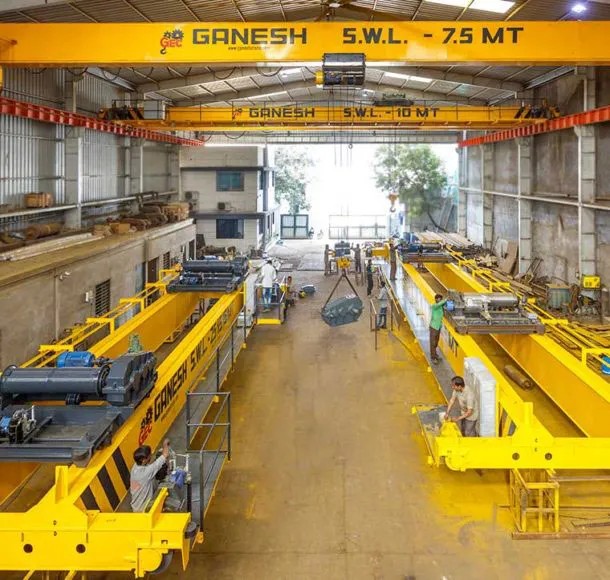
Surat runs two completely different industrial worlds side by side: high-speed polyester and weaving mills in Pandesara and Sachin GIDC, and heavy plate fabrication and steel complexes along the Hazira port belt. Selecting the wrong crane capacity or duty class for either environment leads to motor overheating, premature rope wear, or unnecessary structural expense on factory columns.
Textile mills in Pandesara and Sachin typically require 1 t to 5 t single girder EOT cranes for lifting warp beams, sizing rollers, and weaving loom frames. By contrast, heavy fabrication shops and coil yards in Hazira specify 10 t to 75 t double girder EOT cranes for moving steel plates, pipe spools, and hot-rolled coils.
In a weaving or texturizing shed, beam weight rarely exceeds 2,000 kg, yet aisle widths between looms remain narrow. A compact single girder bridge with an underslung or low-headroom hoist clears roof trusses while keeping column wheel loads light.
Inside Hazira fabrication yards, operators lift multi-ton structural sub-assemblies, pressure vessel shells, and raw steel bundles continuously across wide spans up to 35 meters. Twin box girders with a top-running crab trolley give the hook extra vertical clearance between the main beams, allowing tall workpieces to turn safely over shop-floor jigs.
When a Hazira bay handles both 50 t plate blocks and lighter 10 t rigging frames, fitting an auxiliary hoist on the same crab speeds up daily turnarounds without running the main heavy drum at slow speeds.
Textile beam handling operates intermittently across shifts and fits Class II (M5) medium duty under IS 3177. Heavy steel plate fabrication, coil yards, and port-side workshops in Hazira run continuous multi-shift lifts and require Class III (M7) or Class IV (M8) heavy duty drives.
Duty classification under IS 3177 and IS 807 measures how many hours per day a crane runs and how close average lifts stay to maximum rated load. Oversizing a textile bay to Class IV wastes capital on heavier girders and motors, while under-sizing a Hazira steel shop to Class II causes gearbox oil overheating and contactor pitting within months.
For Surat textile mills, Crompton or Siemens S4 crane-duty motors paired with variable frequency drives (VFD) provide soft starts that stop warp beams from swinging over delicate yarn creels. Operators use 24 V pendant drop stations or wireless radio remotes to walk alongside narrow loom alleys.
For Hazira steel bays, heavy electro-hydraulic thruster brakes, hardened helical oil-bath gearboxes, and cabin or long-range radio controls handle demanding shift schedules without thermal tripping.
Comparing duty classes, structural spans, and drive hardware side by side helps plant engineers match crane specifications to shop-floor conditions before issuing a purchase inquiry.
| Parameter | Surat Textile Mills (Pandesara / Sachin) | Hazira Heavy Steel & Fabrication |
|---|---|---|
| Typical Capacity | 1 t to 5 t Single Girder | 10 t to 75 t Double Girder |
| IS 3177 Duty Class | Class II (M5) Medium Duty | Class III (M7) / Class IV (M8) |
| Bay Span Range | 8 m to 20 m | 15 m to 35 m |
| Primary Control | 24 V Pendant or Radio Remote | Radio Remote or Operator Cabin |
| Surface Protection | Epoxy Primer + Lint-Sealed IP55 | SA 2.5 Blasting + Marine Epoxy |
| Drive Enhancement | VFD Dual-Speed Soft Start | VFD + Auxiliary Hoist + Thruster Brake |
Coastal humidity and salt spray around Hazira corrode bare mild steel and open switchgear contacts rapidly, while humid steam and fine polyester lint inside Pandesara dye houses clog open motor fans. Both environments demand SA 2.5 blast cleaning, multi-coat epoxy paint, and IP55 sealed electrical enclosures.
At Ganesh Engineering Co. in GIDC Vatva, Ahmedabad, our fabrication team builds girders from certified Tata and SAIL steel plates, preparing surfaces thoroughly before applying anti-corrosive epoxy primer and weather-resistant finish coats.
Electrical panels, rotary limit switches, and junction boxes are gasketed to block lint and salty moisture. Shrouded four-pole copper DSL busbar systems prevent accidental contact and eliminate bare-conductor sparking along dusty or damp shed walls.
Usha Martin high-tensile wire ropes wind onto CNC-grooved drums with precision rope guides, ensuring smooth spooling even when humid air challenges basic workshop maintenance.
Finished EOT cranes travel roughly 270 km south from Plot No. 2601/B, Phase-IV, GIDC Vatva, Ahmedabad along NH 48 on flatbed or low-bed trailers. Long spans ship in match-marked bolted splice sections so site erection requires zero field welding.
Every crane clears static load and girder deflection tests on our Vatva shop floor before trailer loading. Hoist assemblies, end carriages, and pre-wired control panels arrive in numbered crates alongside general arrangement drawings.
Once trailers reach Sachin, Pandesara, or Hazira, our erection engineers inspect shed bracket elevations, align runway rails within tight tolerances, mount DSL power conductors, and verify all safety limit switches and brakes under supervision before handing over the bay.
Every crane built at Ganesh Engineering Co. follows IS 807, IS 800, IS 3177, and IS 4137 design standards, backed by factory load and deflection verification before leaving Ahmedabad. Buyers receive verified material specifications for Tata and SAIL steel plates, Usha Martin wire ropes, and Crompton or Siemens drive motors.
During fabrication in GIDC Vatva Phase-IV, our 26 to 50 person team checks box-girder weld seams, diaphragm spacing, and upward design camber so full-load vertical deflection stays strictly within Indian code limits. End carriages are line-bored to keep forged double-flanged wheels parallel, preventing rail flange scrubbing and uneven wear along your factory runway.
Before trailer loading, each hoist and bridge assembly undergoes mechanical running trials, brake-holding checks, rotary limit-switch calibration, and full rated load and deflection measurement on our test bay. This ensures that when parts reach your site, electrical panels and mechanical assemblies match the approved general arrangement drawing without hidden defects.
Checking shed column bracket levels, runway rail gauge, and three-phase 415 V power readiness before trailers arrive cuts site erection time in half. Confirming clear trailer gate access, overhead door clearance, and mobile unloading crane positioning also keeps installation moving smoothly from day one.
Plant engineers should verify that gantry rail joints are welded or bolted flush, end-stop buffers sit securely at bay extremes, and earthing leads reach the main runway isolator switch. Having an electrician ready to terminate the shrouded four-pole copper DSL busbar feeder lets our visiting Vatva technicians move straight from mechanical erection into final travel and hoisting checks without unnecessary waiting.
Start by sharing your required safe working load, bay span, hook lift height, and daily operating hours with our GIDC Vatva, Ahmedabad plant on +91-9824089366 or info@ganeshcrane.com. Every crane is designed to IS 807, IS 800, IS 3177, and IS 4137 rules using Tata and SAIL steel, Usha Martin wire ropes, and Crompton or Siemens motors.
Before trailer dispatch, every machine undergoes full load and deflection verification in our Vatva bay. For international buyers across 28 export markets including UAE, Saudi Arabia, Nepal, Bangladesh, Sri Lanka, Indonesia, Sudan, Kenya, and Nigeria, spliced girders and crated hoists ship in export packing with clear wiring diagrams and bolt schedules. You can review full technical parameters on our Double Girder EOT Crane page, inspect regional supply details on EOT Cranes in Surat, and examine past heavy-lifting installations on our case studies page. Orders settle cleanly via LC, DD, cheque, or card with GSTIN 24AAHFG9482D1ZB invoicing.
Yes. A low-headroom single girder hoist mounts beside the bottom girder flange instead of directly beneath it, reclaiming vertical hook lift without raising the shed roof.
Standard single girder EOT cranes start around Rs 1.5 lakh per piece ex-Vatva, while double girder units start near Rs 5.4 lakh depending on exact tonnage, span, and lift height.
We fabricate structural box girders from Tata and SAIL steel plates and fit Usha Martin wire ropes alongside Crompton or Siemens S4 crane-duty motors.
Buyers settle invoices under GSTIN 24AAHFG9482D1ZB via LC, DD, cheque, or card, with direct technical support on +91-9824089366.
Understand EOT crane pricing in India using real factory benchmarks: single girder from Rs 1.5 lakh, double girder from ...
When a mobile rubber tyre gantry crane without fixed floor rails saves foundation cost and adds yard flexibility, featur...
Compare heavy gantry cranes vs tower cranes for bridge girders, precast yards, and temple construction, featuring our 10...
Send us your capacity, span and lift height. Our engineers reply with a design and quotation.
Share your requirement. We usually reply the same working day.